Showing posts with label Lists. Show all posts

22.8.11

My Week Off

Summer semester over! Woot!
I got a well-earned A in Art History, which was by far my favorite class in college so far. It was frighteningly difficult, and therefore exhilarating.

I got an ill-earned B in Psychology, which I'm fine with. I was so burnt out that I somehow justified skipping three quizzes so I could spend more time in Tumblr. I honestly am so over it.

I have a new major, a new set list of classes to take over the next three years, and I am seriously so excited. Why did I ever think this wasn't for me? I get to take Advanced Poetry Writing, Topics in Shakespeare, Rhetoric in Literature, and The Great American Novel. Classes like those make me drool and swoon, and other double "oo" words.

So, what to do with a week's break? I have big plans.
I'm watching a few movies:
Nick and Norah's Infinite Playlist
Blue Valentine
Marie Antoinette
I'm watching a marathon of this:
Gilmore Girls

I'm listening to these:
BYU's classical music station
Modern Scholar audio books, and don't judge me!
Burst Apart by The Antlers
I'm eating these:
Frozen Greek yogurt: GODSENT!
Larabars: Hey, I know all these ingredients!
Chocolate covered espresso beans... 
I'm reading this:
U2 by U2
And that's about it!
But let's be honest. About one day into this lounging, relaxing, ridiculous week off, I'm going to go nuts and need to start "creating." Blah. What's wrong with me, that I can't watch eight straight hours of TV in a row? I'm a disappointment to my generation.

Anyways, happy week off! And I'll leave you with this tweet of mine, from a while ago. It sums up my lack of summer vacation.

"Anyone else ready for their neighbor kids to be babysat by unsuspecting, underpaid teachers?"

28.6.11

Lessons From Art History, Part Four of Four


LIFE LESSON FROM MILLAIS: 
Great work inspires great work

I used to stare at this painting as a little girl. It was one of the only color photos in my dad's old edition of Art Throughout the Ages by Gardner. It's a depiction of Ophelia from Hamlet, her drowning, which always broke my heart--not just because she drowns herself, but because the actual act is only described through a gorgeous monologue and I always wished we could actually see it onstage. My dad's book was the seventh edition. I looked at this painting in mine. Mine is the thirteenth edition. That's called ties that bind.
Also, the landscape in this painting? Unbelievable. Millais sat at the Hogsmill River banks, sketching and painting, for eleven hours a day... for five months. The Royal Academy critics tore it to shreds--there was an outcry that Millais had portrayed lovely Ophelia as a dairy maid drowning in a muddy ditch... It wasn't until Salvador Dali in the 1930s saw this painting and championed it as a Romantic classic. It is valued at around $15 million.

LIFE LESSON LEARNED FROM J.M.W. TURNER:
It takes one to know one.
Joseph Turner was a Romantic (not Impressionist) painter who captured the color of scenes with his loose brushstrokes, washes of paint, and ethereal atmospheric effects. This man painted delicately but was a passionate giant. He once tied himself to the mast of a ship to experience the drama of sea storms. He would sketch clouds for three or four days straight before exclaiming, "There it is!" and painting the masterpiece in about six hours' work. He died and left his entire fortune to an almshouse for "decayed artists." His last words, as he died, were, "The sun is God!"
The man's name is not well known, but he inspired the Impressionists and a prize is given in his name to exemplary painters in England each year.

LIFE LESSON LEARNED FROM CAMILLE CLAUDEL:
Sometimes you need a woman's touch

Camille Claudel was the (arguably mildly insane) woman who became Rodin's lover in 19th century France. A sculptor herself, Claudel worked as an apprentice in Rodin's workshop. She quickly became his confident, his model, his friend... and his lover. The affair upset Rodin's family, his wife, his followers, so she left his workshop and set out for a career of her own.
We hear Rodin's name all the time as an almost-equivalent to Michelangelo when it comes to talented sculptors. Claudel's work has the skill of a Rodin with the passion of a Michelangelo. She died in an asylum after living there for thirty years, completing much of her work there. If history students were taught influential female names as well as the male ones, her name would be towards the top of the list.

LIFE LESSON LEARNED FROM MONET:
Capture the fleeting moment
I have already posted about my love for the Impressionist movement, so I'll be brief. We studied the mottos of Monet, Renoir, and Pissarro, which was to paint as quickly as possible so as to capture that moment in time on a canvas. They focused on color, not form. They painted not in studios, but in nature, so as to observe and paint correctly what beauties they saw. They used the broken brushstroke, so they wouldn't have to muddy their paints by mixing them together (each time you mix a color from its tube on your palette, the color becomes duller). They chose to allow colors to mix in the eye. They are the painters who captured the phrase CARPE DIEM. Seize the day. Seize the moment. Make an impression.

LIFE LESSON LEARNED FROM WHISTLER:
If you like it, you should hang it on a wall.


This is Nocturne by Whistler, a rebellious American-born British painter who pushed the idea of "art for art's sake." He was of the opposite opinions than the Impressionists--he believed line was more important than color, and that black (which the Impressionists banned from their paintings) was the most important aspect in creating harmony on a canvas.
I don't know why I love this painting. But I do. It's dark but still luminous. It's hazy but still truthful. Someday I want a print of it to hang in my bedroom. It's something I would want to look at every night.

LIFE LESSON LEARNED FROM DUCHAMP:
Not everyone will get you--as an artist, as a person
Duchamp was a French painter who led the Dada movement (the anti-art movement) in which statements were created in art to challenge our ideas of what makes art art. (Lots of art) This is Nude Descending a Staircase. Can you see it?
I happen to love it. I can see why someone wouldn't. The Academy said, "Nudes do not descend staircases; nudes recline." But the breakthroughs in art are because of this man, Duchamp, who continually pressed the limits with his work. His most controversial (and crazy) work? A urinal, displayed in an art gallery in Paris, entitled Fountain.


LIFE LESSON LEARNED FROM THE FAUVS:
Think outside the box.


The Fauves: the wild beasts. Fauvism was a short-lived movement in the early 20th century where artists chose to use expressive color rather than local color. I never thought I'd fall in love with this, but I did. Hard. Matisse said, "There is nothing more difficult for a truly creative painter than to paint a rose, because before he can do so, he has to first forget all the roses that were ever painted."

This class ended. I am sad. But I have already begun to see the applications of this class, popping up in movies, books, and even a walk to the park.

22.6.11

Lessons From Art History, Part Three of Four

LIFE LESSON LEARNED FROM GENTILESCHI
Paint what you know.

Artemisia Gentileschi was a female Italian painter in the 17th century who was a fan of Carvaggio's style and work. Her paintings are mostly of women, and her series of Judith slaying Holofernes becomes particularly powerful when you learn that the artist herself was a rape victim. Her painting tutor sexually assaulted her, and she was tortured with thumbscrews during the trial to ensure her honesty. She won. The man went to jail. She paints with strength because she is strength.

LIFE LESSON LEARNED FROM FRAGONARD
There's a time and a place for the frivolous 
The Swing is one of the most famous images of the Rococo era, a time in history and culture when the classes were divided, Marie Antoinette's head was just months away from earning a reservation with Madame Guillotine, and art reflected the oversaturated, frivolous, hypocritical lifestyle of the French aristocrats.... And I freaking love it. What point is there to art if not to over-romanticize and over-beautify life? Reality is ugly.

LIFE LESSON LEARNED FROM BOUGUEREAU
If you really love painting (and women), it will show in your art
My God: no one can paint flesh or woman figures like Bouguereau. I wish I could commission him to paint me... but he's dead.

LIFE LESSONS LEARNED FROM DELACROIX AND INGRES
Art wars are badass.
Top: Grand Odalisque by Ingres
Bottom: Liberty Leading the People by Delacroix
Said Ingres to Delacroix, "It takes twenty-five years to learn to draw, one hour to learn to paint."
Said Delacroix to Ingres, "The artist who aims at perfection in everything achieves in it nothing."
And so on.

14.6.11

Lessons From Art History, Part Two of Four

LIFE LESSON LEARNED FROM BOTTICELLI
Do your own thang; haters gonna hate.
Botticelli's work is beloved today. It is light, colorful, joyful, with beautiful mythological subject matter, long, lithe figures, and Disney-worthy landscapes. It completely went against art trends of the time--instead of being rationally executed, with correct proportions and accurate atmospheric perspective, it is poetic. Lovely. Botticelli's work was criticized until the 19th century. Haters gonna hate.


LIFE LESSON LEARNED FROM LEONARDO DA VINCI
Lines should be blurred
Sfumato: blending of harsh lines in artwork; a misty, foggy, hazy effect which adds roundness to figures. 
Lines should be blurred. Labels should be mixed, removed, harsh edges should be removed. Softness is key.


LIFE LESSON LEARNED FROM CARAVAGGIO
You mess with the Pope, you'll get the horns
Caravaggio was commissioned to create a version of St. Matthew being inspired by an angel to write his gospel. The piece would hang as the main artwork on the altarpiece (the spot behind where the priest would offer the sacrament in a cathedral). This was his submission (originally in color; the painting was destroyed during World War II. Thanks a lot, Hitler!)
I adore this painting. The church, however, did not. To them, this showcased St. Matthew as a barely literate, peasant with bare feet having an angel literally write his words. To them, the angel's relationship with Matthew teetered on flirtatious, which was inappropriate. Most cleverly, the bare feet were exactly at the level of the holy water when the painting was hung. Caravaggio was asked to remove the painting and make a more appropriate commission. (P.S. It's boring!)
I just love art that pisses off Popes. But can we even begin to list the amazing masterpieces that were at one time condemned or frowned upon by the church? Hint: most of them are ones we love and admire today. Infallible my ass!


Part three coming soon!

9.6.11

Lessons From Art History, Part One of Four

I don't think a subject, class, or professor has ever before moved me to... not to tears, or triumph, but some strange combination of the two.

Do you have any idea what is shaped by art? What shapes art? Do you know that each brush stroke created by these famous painters was motivated by some sort of rebellious social movement? That the reason we wear the clothes we wear, live in our houses, even know what a painting is--it's all from these masters?

To hear someone call out a beloved painting of yours as "the death of art" or a favorite artist as "the anti-Christ of painters" rings offensive in the way it would if someone slapped your face. Life lessons are abundant if you search for them. Here are things I have found while sitting in this marvelous class. If you are taking courses at Utah Valley University, I recommend this mind-expanding class. It hurts to stretch your boundaries. In a good way.

LIFE LESSON LEARNED FROM GIOTTO:
One person can change it all.
Chiaroscuro: shadows, value contrasts, the many shades of grey between light and dark. You wouldn't think that a simple inclusion of this into a singular painting would revolutionize figure painting, yet it did. And what a good thing to be aware of--all the shades of grey that exist in the world, in your life, in people. We are not a black and white world, we are shades of grey.


LIFE LESSON LEARNED FROM MICHELANGELO:
Carve until you set something free.
Michelangelo refused to use proportions, measurements, and other confounded entrapments of the Renaissance standard for beauty. He chiseled away at a block of stone until a masterpiece revealed itself, and he used only his eye to judge. He broke/refused the set standards of the time, and in doing so he broke the mold... and set new standards which we adhere to today: an artist's only measurement of greatness should be his own intention and eye.


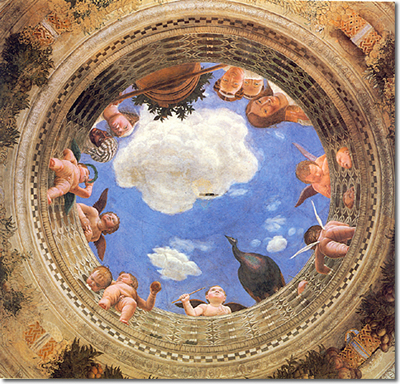
LIFE LESSON LEARNED FROM MANTEGNA:
A little bit of humor goes a long way.
This is a piece of the Camera Picta which is a painted illusory ceiling... above a marriage bed. Cupids peek over the ledge at what the couple could be doing, a peacock (symbol of ferility) stands overhead... this is all on a flat surface, people. 


More to come!

24.4.11

My Three Most Quoted Movies

Reilly hath dubbed them. I should be embarrassed or something.

23.4.11

Options for Fiction Reading, Part Three of Four

Ramona the Pest by Beverly Cleary
"Why don't you turn on the dawnzer? It gives a lee light."
Beverly Cleary has an ageless appeal. I look back on this fondly as the first chapter book I read, and before I could read it myself, I listened to it on tape until the ribbon wore out. Just last summer, I broke it out and flipped through the pages, excited for the day when Finley will press repeat on her tape player iPod, listening to Ramona play Grey Duck over and over again. The best thing about Ms. Cleary, in all of her books, is her ability to sneak in very realistic humor about children, how their worlds work, and how they view adults. What I appreciate now as an adult about these books, however, is that her characters are always spunky but never sassy, unlike all modern replicas of Ramona (I'm looking at you, Clementine).

Cat's Cradle by Kurt Vonnegut
"Peculiar travel suggestions are dancing lessons from God."
Okay, so I have maybe mentioned this book on this blog a few times, but it's another one that just--ugh, I can't describe it in any new way. It's been reviewed a million times, and each person seems to stutter like I do, trying to find the words to do it justice. I didn't read my first Vonnegut until a few months after I graduated from high school, and even though this isn't specifically written as a young adult novel, I often wonder what effect it would have had on me if I had read it earlier. The story begins with John, the narrator, who decides to write a book on where important Americans were the day the first atomic bomb was dropped. He first interviews a fictional physicist, Felix Hoenikker, and John realizes that the scientist may have left behind a substance that could threaten life on earth.
The most fantastic thing about this book is how cyclical it is. Every chapter you read, you leave behind a certain setting for another one. Nothing is mentioned that is not brought in again for some sort of metaphor. In this book, Vonnegut (a well-known atheist) centers around the juxtaposition of religion and science, and points out the flaws in each of them through this story. So good. MUST be read.

Lolita by Vladimir Nabokov
"I am sufficiently proud of my knowing something to be modest about my not knowing all."
I adore Russian literature. Tolstoy, Dostoevsky, Pushkin, Gogol, Chekhov, Bulgakov--I love them. Nabokov does something to me in particular, and there is a reason why Lolita, despite its slightly discomforting subject matter, is the greatest of his works. We're all familiar with the story: the self-deprecating but incredibly insightful narrator Humbert Humbert recounts with deep shame but brutal honesty how he fell in love with twelve year-old Dolores, whom he calls Lolita. The most brilliant insertion Nabakov brought into this seemingly disgusting novel was endowing Humbert, a known pedophile, with wit, charm, and a bewitchingly sophisticated prose style. Beautiful book. Just stunning. 

White Oleander by Janet Fitch
"Remember it all, every insult, every tear. Tattoo it on the inside of your mind. In life, knowledge of poisons is essential. I've told you, nobody becomes an artist unless they have to."
I have to be honest: I glanced at this book on the library shelf for two years and ran screaming in the other direction because it had the sticker with the dreaded words on it: "Oprah's Book Club." Then when I finally read the first paragraph, three days later I realized I had finished it. Again, this is not a book for the faint of heart. It deals with murder, cruel foster homes, child/adult sexual relations, drug use, and, most intriguingly, a manipulative mother who insists her daughter grow up knowing poetry rather than basic arithmetic. This is a dark book, but the author weaves in lightness through her fresh metaphors. It's literary fiction of the highest kind. 
Astrid Magnussen is a young teenager, living with her mother Ingrid, who is an artist and poet who fights fiercely. When Ingrid's boyfriend leaves her, she exacts her revenge by poisoning him with oleander flowers. She is arrested, sent to prison, and we follow Astrid on her journey from foster home to foster home, with her mother's controlling letters serving as mileposts through the story. I re-read this every summer when the wind gets warm.

The Jungle Book by Rudyard Kipling
"There is no harm in a man's cub."
No child should grow up without reading the stories of the jungle, because every child imagines what it would be like to be raised by a pack of wolves, defeating deadly tigers, wrestling with snakes beneath the canopy of the trees, growling in the river with a bear. If Finley had been a boy, her middle name would probably have been Kipling. We all know the story: Mowgli is a man-cub who grows up away from humans under the watch of his Brothers of the Pack. Kipling pours on childhood fantasies in this book. Read it. Find an illustrated version. I think if the world was ending, this is the book I'd want tucked underneath my arm.

The final part coming soon!


21.4.11

Currently Striking My Fancy

The Celebrity Apprentice, which is kind of like the slower, dumber version of what used to be my favorite reality show, The Apprentice. Team Marlee!
 Trying to find a new pair of glasses frames, since Finley smacked me and broke mine. Do I go with hipster?
 Grandma?
 Or professor? I can't decide which kind of nerd I want to be.
 Cozy bedrooms...

These wood carvings of images from The Queen of Spades, a fantastic short story by Pushkin which was adapted into an opera by Tchaikovsky.
 And finally, Hobby Lobby!
 This is where I got a new set of acrylics, a new pack of paintbrushes, and a blank canvas for under ten dollars! Now if only they sold free time so I could finish a painting...